
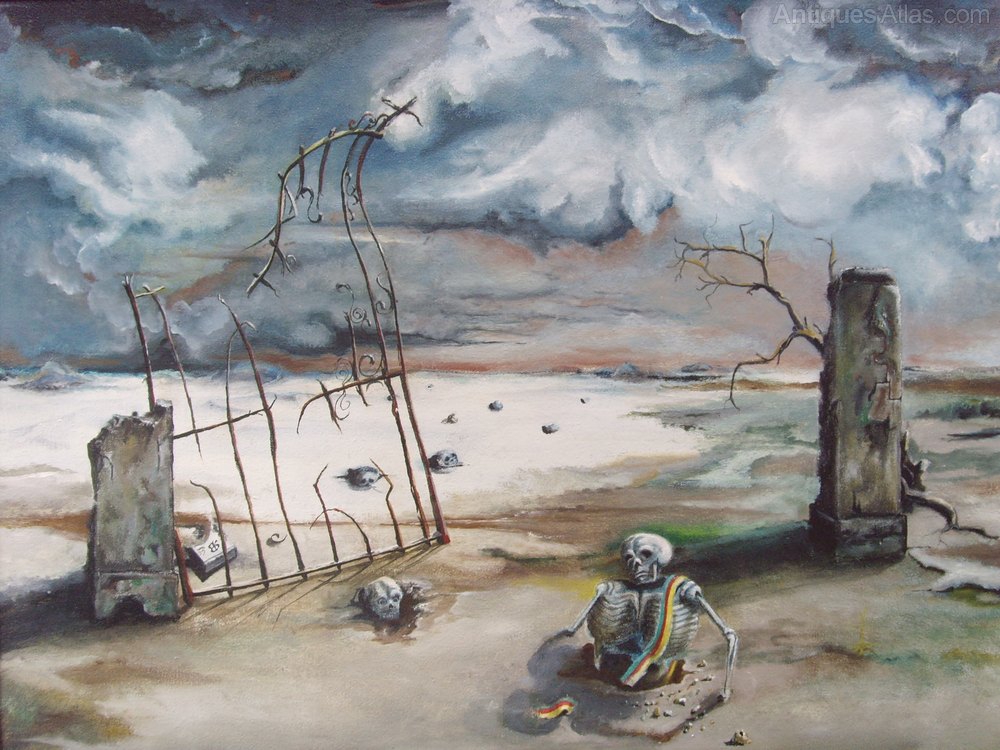
The Gates (1966) Riccardo Benedetti ‘ …

An incredible piece of surrealist art. Maybe it should be re-named ‘ Western enlightenment post Gaza 2024‘ ? It reminded me of many ‘images’ from the work of Ezra Pound (d 1972).

For all his failings, Ezra Pound was, in many respects, as well as a great poet, literary ‘agent’, a prophet out-of-his-time: He once wrote thatThe ang-sax race as a whole or hole, very insensitive to mental rot and decomposition. Eng. much worse than U.S.England insensitive to mental decay. U.S. silly, incomparable shallowness and triviality’. Ezra Pound. Letter to Homer Pound, May 1925. Letters to His Parents.

And the profound words from his ‘ Hugh Selwyn Mauberly (1920) also known as his ‘Farewell to London’, as he struggled to make sense of the Great War, a war that in many respects is still being fought today …

These fought in any case, and some believing, walked eye-deep in hell

believing in old men’s lies, then unbelieving came home, home to a lie,

home to many deceits, home to old lies and new infamy; usury age-old and age-thick

and liars in public places.

There died a myriad, And of the best, among them,

For an old bitch gone in the teeth,

For a botched civilization,

Charm, smiling at the good mouth,

Quick eyes gone under earth’s lid,

For two gross of broken statues,

For a few thousand battered books.

So, when Zionist Israel says it is fighting for Western civilization against barbarians, what kind of civilization is it really fighting for!

The Gaza story is being told daily for those who have eyes and ears to see and listen …

How do you tell a story that was never supposed to be told? The Calvert Journal talked to the artists capturing the scale and emotion of the Soviet Union’s notorious repressions for the new journalistic project, Generation Gulag, from Coda Story.

‘This is not ancient history’: meet the artists bringing the devastating stories of Stalin’s repressions to life  https://www.new-east-archive.org/features/show/11542/generation-gulag-coda-story-art-stalin-repressions-oral-history via @calvertjournal

Fast forward from Bolshevik USSR to Zionist Israel …

Netanyahu’s Palestinian genocide is a story that is already being told and documented in so many different ways: https://www.bbc.co.uk/news/world-middle-east-68249962 – Gaza Genocide Case Against Israel Gathers Global Momentum: S. Africa Envoy – Politics news – Tasnim News Agency https://tn.ai/3172790 – Montage gathers Israeli soldiers’ videos of war crimes in Gaza https://www.middleeastmonitor.com/20240408-montage-gathers-israeli-soldiers-videos-of-war-crimes-in-gaza/ via @middleeastmnt … etc etc etc etc etc

Hundreds of thousands of sources will be collated, one day, as a record of “man’s inhumanity to man” (Primo Levi) in the twenty first century … nay, the Western elite’s inhumanity towards the Palestinian people.

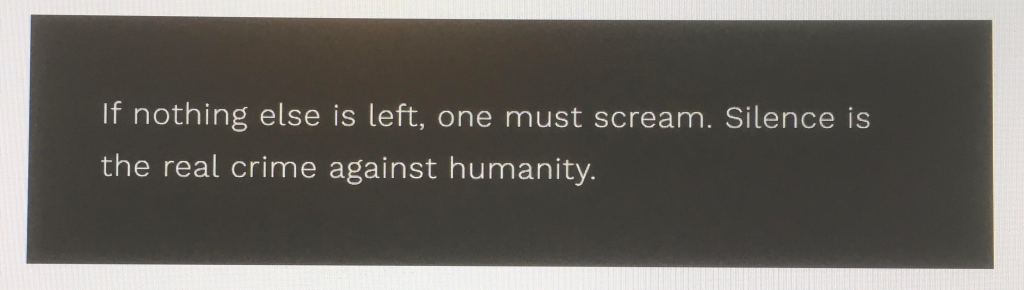
If nothing else is left, one must scream. Silence is the real crime against humanity.

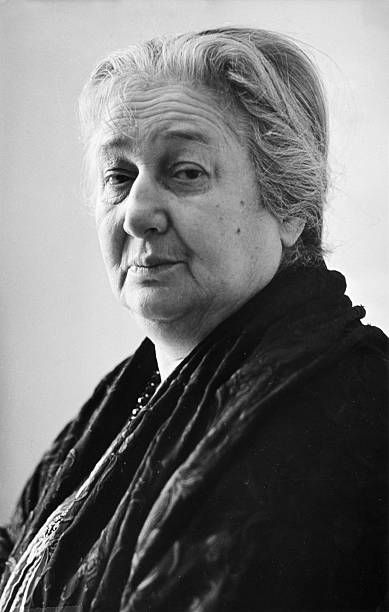
Nadezhda Mandelstam’s book  ‘Hope against Hope’ (1970) is a study of what happens when a society lurches out of control and begins to cannibalize its own citizens. The greatest weapon dictatorial governments have is to make everyone culpable. The ultimate consequence is a society where no one, not even the most powerful despot, has ultimate control.

No one can say “stop” and have order restored; the sickness is, by that point, in every cell of the body political.

It is the national version of original sin.

Nadezhda goes on to write: Anybody who breathes the air of terror is doomed, even if nominally he manages to save his life. Everybody is a victim – not only those who die, but also all the killers, ideologists, accomplices and sycophants who close their eyes or wash their hands – even if they are secretly consumed with remorse at night.

Every section of the population has been through the terrible sickness caused by terror, and none has so far recovered, or become fit for normal civilian life.

If nothing else is left, one must scream. Silence is the real crime against humanity.

Edvard Munch’s Scream 1893

But around him a crowd of thin-necked henchmen

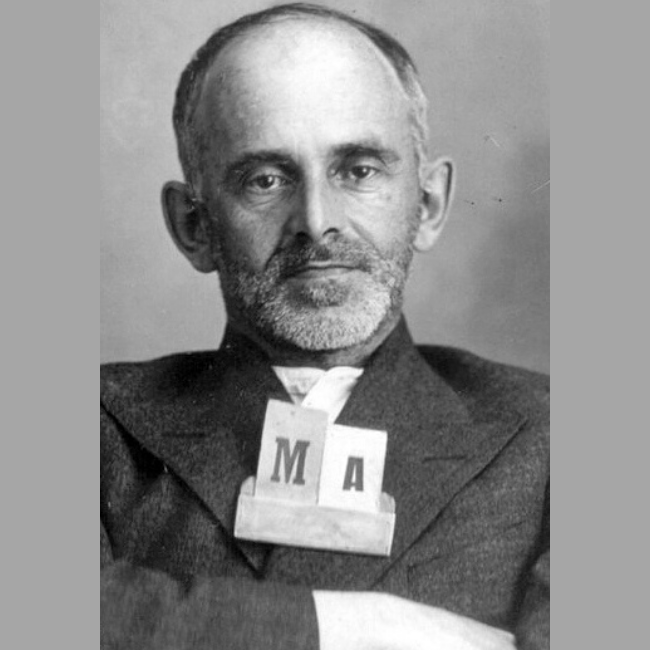
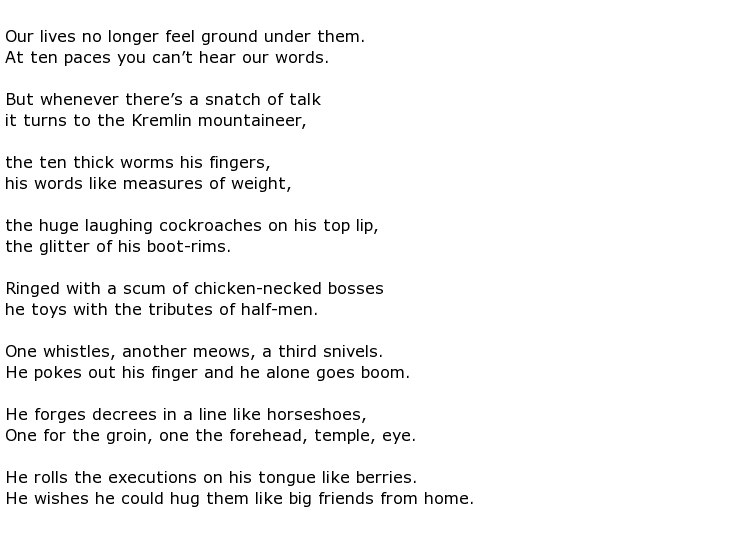
Ode to Stalin (Stalin Epigram) November 1933 by Osip Mandelstam

This poem, which Mandelstam read to a small circle of friends, was reported to the authorities, leading to Mandelstam’s exile in 1934. ‘Been thinking – who is going to write an ‘Ode to Netanyahu 2024‘? Maybe I should have a go. Here is the ode that Osip died for.

We are living, but can’t feel the land where we stay,
 More than ten steps away you can’t hear what we say.
 But if people would talk on occasion,
 They should mention the Kremlin Caucasian.
 
 His thick fingers are bulky and fat like live-baits,
 And his accurate words are as heavy as weights.
 Cucaracha’s moustaches are screaming,
 And his boot-tops are shining and gleaming.
 
 But around him a crowd of thin-necked henchmen,
 And he plays with the services of these half-men.
 Some are whistling, some meowing, some sniffing,
 He’s alone booming, poking and whiffing.
 
 He is forging his rules and decrees like horseshoes –
 Into groins, into foreheads, in eyes, and eyebrows.
 Every killing for him is delight,
 And Ossetian torso is wide. (Tr. Dmitri Smirnov)

Another translation

And bake (them) morsels of fresh bread

Morning eyelash, don’t arise!
Give us our daily bread,
Lord…!

………

And at this cold hour, when earth

smells of to human dust and is so sad,

I would like to knock on all the doors,

and to beg I don’t know whom, forgiveness,

and to make little pieces of fresh bread

here, in the oven of my heart…!

(From Cesar Vallejo’s ‘Our Bread’)

Gaza Beit Lahiya Bakery (Abdelhakim Abu Riash) 2024

Diolch! Thank you, Anna, for this …

       2. (from VII Secrets of the Craft)

I have no use for battlefield odes,
And the charms of an intricate elegy.
For me a poem must be impromptu—
Not a matter of tradition.

If you only knew what kind of trash
Poems shamelessly grow in:
Like weeds under the fence,
Like crabgrass, dandelions.

An angry shout, the smell of fresh tar,
Mysterious mildew on the wall—
And a poem begins sounding fervent, tender,
Making us all joyful.

Part of pallet fence at Oak Tree House

The voice of the wind I could understand

WILLOW (Anna Akhmatova 1940)

And I grew up in patterned tranquillity,

In the cool nursery of the young century.

And the voice of man was not dear to me,

But the voice of the wind I could understand.

But best of all the silver willow.

And, obligingly, it lived

With me all my life; it’s weeping branches

Fanned my insomnia with dreams.

And – strange! – I have outlived it.

There the stump stands; with strange voices

Other willows are conversing

Under our, under those skies.

And I am silent…As if a brother had died.

‘I grieve for you as for my own’ …this Summer , in the safety of Oak Tree House

But the fir tree forest and the rushes in the pond

Answer with a kind of strange echo …

Oh, if I’m waking the dead,

Forgive me, I can’t do otherwise:

I grieve for you as for my own,

And I envy anyone who weeps,

Who is able to weep in this terrible hour

For the one who lies in the ravine’s depth …

Anna Akhmatova (1938) …

Anna AkhmatovaRussian poet

I wonder if he will grow-up to be a Palestinian poet?

Yes, the garden at Oak Tree House, has fir trees, a pond and a babbling brook. Yes, I do feel guilty, some days, living in the security and beauty of this ‘little-Eden‘.