The “star stuff” that astronomer Carl Sagan famously said we are all made of was forged in the exploding supernova of dying stars.
The phrase isn’t just a pithy remark for a bumper sticker, it’s backed up by science. “All the silver, nickel, and copper in the Earth and even in our bodies came from the explosive death throes of stars,” said NASA scientist Steve Howell in a 2016 statement. “Life exists because of supernovae.”
The extraordinary brightness, energy and other unique qualities of SN2016aps suggest to scientists that it could be the result of an extremely rare event known as a pulsational pair-instability supernova. These rare events occur when two massive stars merge before exploding.
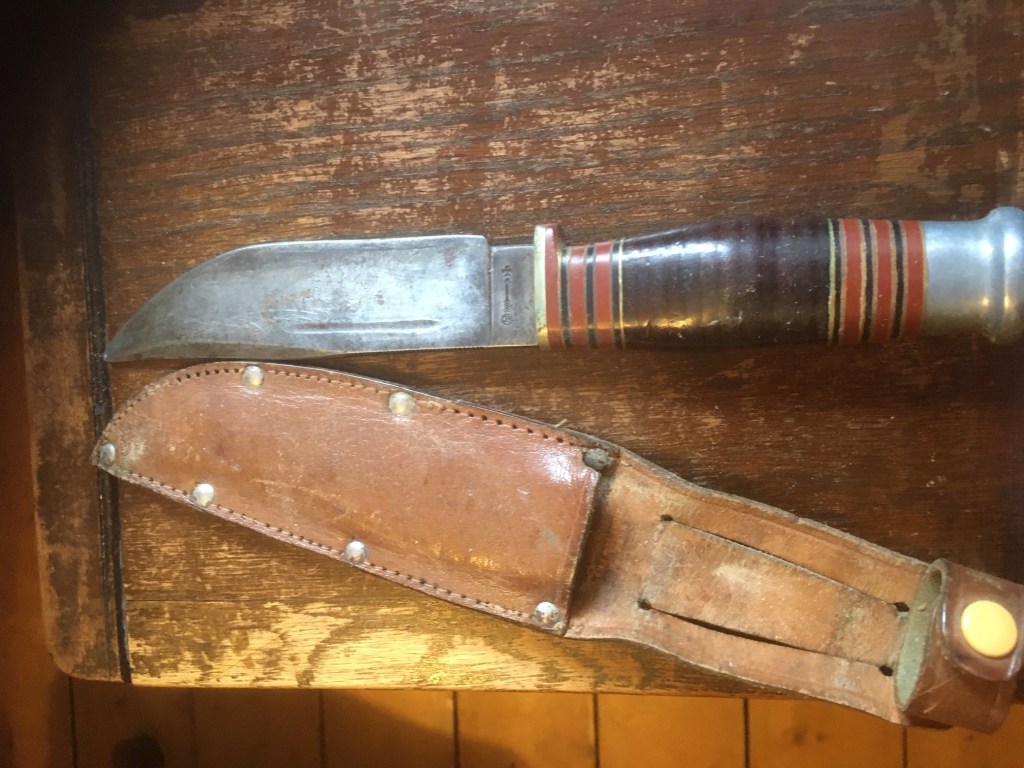
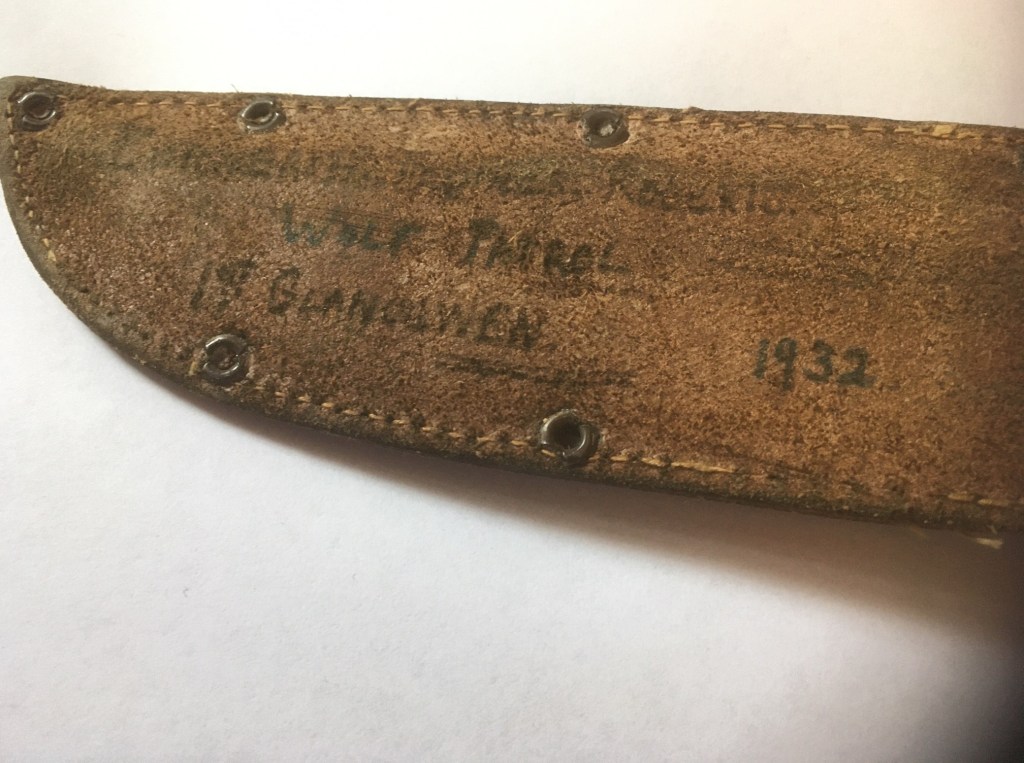
It was my father’s scout knife, which we think he may have been passed on by an older relative. He wrote on it: “IORWERTH (?) ROBERTS, WOLF PATROL 1ST GLANOGWEN 1932” (Bethesda, NW Wales)
c. late 1920s ‘Boone’ Bowie Hunting Knife Wolf Patrol 1st Glanogwen (Bethesda)
‘Hey, Selwyn, you never told me. Why did you give up the missionary business?’
Never did. It gave up on me. I got another germ, see?’
‘No.’
… ‘It’s my theory that religion is like a disease. A great religion’s like an epidemic. Take Christianity, Mohammedanism, Buddhism. Just like epidemics. Start in one place, always spread along the trade routes, flourish for a few hundred years and die out. Or get overrun by a new epidemic. I was sent here like a germ, to infect you people. Instead,’ he shrugged, ‘you infected me.’
What God is he, writes laws of peace, & clothes him in a tempest What pitying Angel lusts for tears, and fans himself with sighs What crawling villain preaches abstinence & wraps himself In fat of lambs? no more I follow, no more obedience pay!
William Blake in “America: A Prophecy” (1793). Spoken by “Boston’s Angel”.
Between 8 September 1941 and 27 January 1944, 2 million lives were lost, including about a million civilians (40% of the city’s population), during the siege of Leningrad (St Petersburg, the ancient capital of Russia) which lasted 872 days or 2 years, 4 months and 5 days – one of the longest, most brutal and destructive sieges in human history, and possibly the costliest in casualties suffered.
During the first winter the temperature dropped to -40 F.
Soviet forces managed eventually to open a narrow land corridor to the city. Around 1.4 million people were rescued by military evacuation.
Some historians classify the siege as genocide.
The siege became ‘an internal battle’, with starvation and isolation tearing into every aspect of everyday life and ‘every recess of the mind.’
Despair permeates the diary of Berta Zlotnikova, a teenager, who wrote: “I am becoming an animal. There is no worse feeling than when all your thoughts are on food.”
Alexis Peri writes: “Leningraders were indeed heroes for all that they endured. They suffered through the unimaginable. What interests me is that, in their diaries, they did not narrate themselves in heroic terms. They did not use the narrative of heroic resistance to describe their fight for survival, but found other ways to make sense of their suffering. They looked to literature, to history, etc.
Horses transport supplies to Leningrad over the frozen Ladoga Lake, dubbed the “Street of Life.”
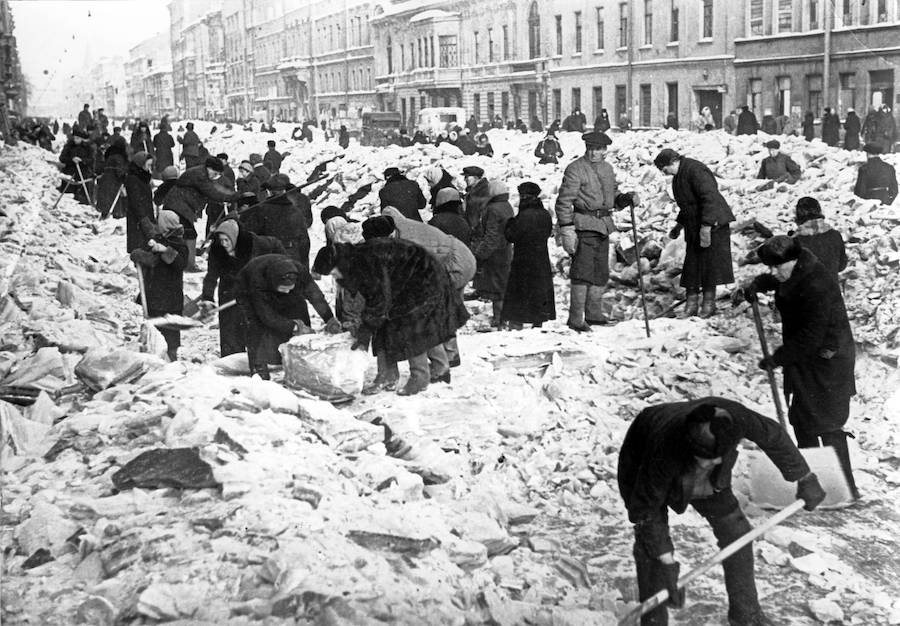
Residents clearing snow and ice. The city declared a clean-up operation to prevent the spread of disease from scattered feces and unburied corpses.
Lamentation
I won’t throw up my hands At the anguish of Leningrad, I won’t wash it with tears, I won’t bury it in the ground. I’ll go a mile beyond The anguish of Leningrad. And not with a glance, not with an allusion, Not with a reproach, not with a word, But with a bow down to the ground In a green field Will I pray.
I love to rise in a summer morn, When the birds sing on every tree; The distant huntsman winds his horn, And the skylark sings with me: O what sweet company!
But to go to school in a summer morn,— O it drives all joy away! Under a cruel eye outworn, The little ones spend the day In sighing and dismay.
Ah then at times I drooping sit, And spend many an anxious hour; Nor in my book can I take delight, Nor sit in learning’s bower, Worn through with the dreary shower.
How can the bird that is born for joy Sit in a cage and sing? How can a child, when fears annoy, But droop his tender wing, And forget his youthful spring!
O father and mother if buds are nipped, And blossoms blown away; And if the tender plants are stripped Of their joy in the springing day, By sorrow and care’s dismay,—
How shall the summer arise in joy, Or the summer fruits appear? Or how shall we gather what griefs destroy, Or bless the mellowing year, When the blasts of winter appear?
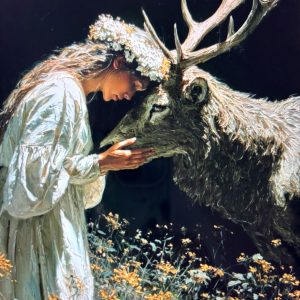





 The Fugitive Stag