Tarkovsky’s search for wholeness, for the integrity of the world, might be read in reductive psychological terms: the separation of his parents in 1935 deeply marked him, and such films as The Mirror and Solaris reveal his yearning for a reassembled family. (His concern with memory, both private and ancestral, is largely reconstitutive.) More importantly, it reflects his preoccupation with spiritual and psychic renewal, dependent in his view on a series of vital connections: with nature, with the past, with originating cultures, including that of pre-revolutionary Russia.

With its holy madmen, saints and seers, and its Dostoevskian themes of atonement, apocalypse and imprisonment, loss of spirituality and hope, Tarkovsky’s cinema has its origins in 19th-century Russian culture (as frequently did Bresson’s).
From -Andrei Tarkovsky: The Poet of ApocalypseJames Quandt 1 October 2018
The “impossible” final shot of Nostalghia: the dacha inside the cathedral
Indeed, my indulgent friends, I will tell you– here, in this late preface, which might easily have become an obituary or a funeral oration – what I sought in the depths below: for I have come back, and – I have escaped. Think not that I will urge you to run the same perilous risk! or that I will urge you on even to the same solitude! For whoever proceeds on his own path meets nobody: this is the feature of one’s “own path.” No one comes to help him in his task: he must face everything quite alone – danger, bad luck, wickedness, foul weather. He goes his own way; and, as is only right, meets with bitterness and occasional irritation because he pursues this “own way” of his: for instance, the knowledge that not even his friends can guess who he is and whither he is going, and that they ask themselves now and then : “Well? Is he really moving at all? Has he still … a path before him? ” – At that time I had undertaken something which could not have been done by everybody: I went down into the deepest depths; I tunnelled to the very bottom; I started to investigate and unearth an old faith which for thousands of years we philosophers used to build on as the safest of all foundations – which we built on again and again although every previous structure fell in: I began to undermine our faith in morals. But ye do not understand me? – Nietzsche in ‘Daybreak’ (1881).
AN EPIC STORY OF LOVE, BEAUTY, RELIGIOUS FANATICISM, AND A SECRET FOR WHICH EVEN THE MOST PIOUS WOULD KILL, TO PREVENT THE WORLD FROM DISCOVERING ...

Goddess and woman conspire in a single numinous form, where there is no separation between the spiritual and the sensual ...  but something altogether new ...
Productions are coming back!After a long hiatus the plans tobegin production are startingto come into focus.That is great news!But something else lurks on the horizon...
The WGA and the major agenciesare still at odds with no end in sight.The smart writers see this as anopportunity to take their work directlyto producers and managers ratherthan trying to land agents.Across the industry, from the UK to the US,producers are looking for the mostcutting-edge scripts!
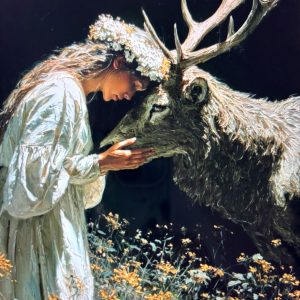
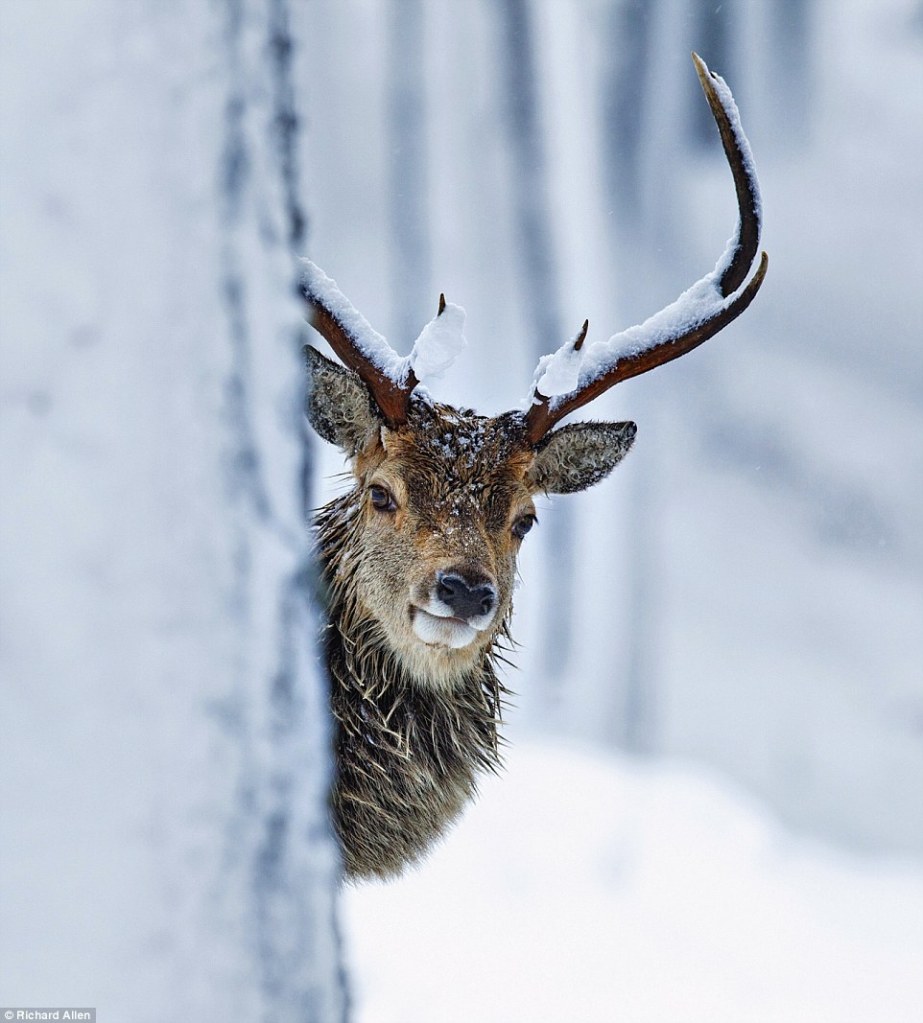
THE FUGITIVE STAG IS READY! Like a bottle in a vast ocean, if you see this blog floating about in virtual space … not just managers and producers … but you may even know someone who knows someone who knows a TOP DIRECTOR looking for a great script … please forward this link. They will be amazed.
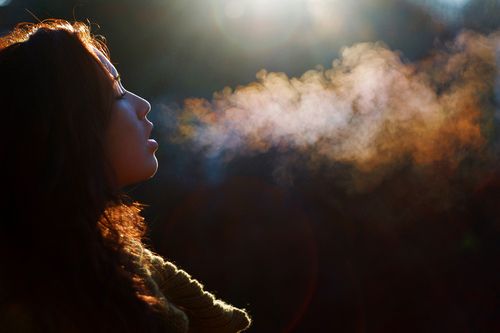
Breathing: You invisible poem!Complete interchange of your own essencewith world-space. You counterweight
in which I rhythmically happen.Single wave-motionwhose gradual sea I am;
you, most inclusive of all ourpossible seas-space grown warm.How many regions in spacehave already been inside me.There are windsthat seem like my wandering son.Do you recognize me, Air,full of places I once absorbed?
You who were the smooth bark,
roundness, and leaf of my words?You who let yourselves feel: enter the breathing
that is more than your own.
Let it brush your cheeks
as it divides and re- joins behind you.
Blessed ones, whole ones,
you where the heart begins:
You are the bow that shoots the arrows
and you are the target.
Fear not the pain. Let its weight fall back
into the earth;
for heavy are the mountains, heavy the seas.
The trees you planted in childhood have grown
too heavy. You cannot bring them along.
Give yourselves to the air, to what you cannot hold.
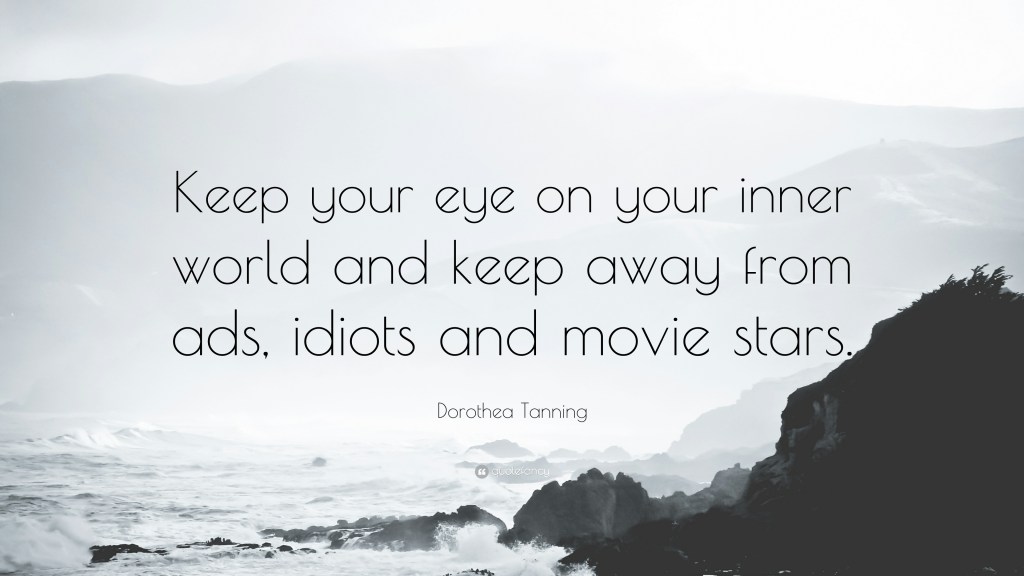
Because it is occasionally possible, just for brief moments, to find the words that will unlock the doors of all those many mansions inside the head and express something – perhaps not much, just something – of the crush of information that presses in on us …
Words that will express something of the deep complexity that makes us precisely the way we are …
And when words can manage something of this, and manage it in a moment of time, and in that same moment make out of it the vital signature of a human being – not of an atom, or of a geometrical diagram, or of a heap of lenses –
but a human being, we call it poetry.
AND THANKS FOR THOSE WORDS, TED – I’M NO POET, SO I CALL IT ‘THE FUGITIVE STAG.’
A FEW DAYS AGO WAS 90 YEARS SINCE TED HUGHES WAS BORN (17.08.30). LOVE THE ‘THOUGHT FOX’ FROM 1957.
I imagine this midnight moment’s forest:
Something else is alive
Beside the clock’s loneliness
And this blank page where my fingers move.Through the window I see no star:
Something more near
Though deeper within darkness
Is entering the loneliness:Cold, delicately as the dark snow
A fox’s nose touches twig, leaf;
Two eyes serve a movement, that now
And again now, and now, and now
Sets neat prints into the snow
Between trees, and warily a lame
Shadow lags by stump and in hollow
Of a body that is bold to come
Across clearings, an eye,
A widening deepening greenness,
Brilliantly, concentratedly,
Coming about its own business
Till, with a sudden sharp hot stink of fox
It enters the dark hole of the head.
The window is starless still; the clock ticks,
The page is printed.
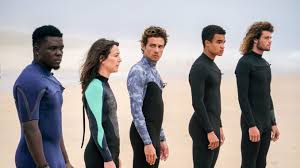
Two very different but both enjoyable series in their own way – with the added attraction that memories of our time/home in The Gironde, France, for a decade, kept ‘invading’ each episode! ‘THE LAST WAVE’ (BBC 4) also reminded us of our ‘last wave’ to No 21 France, as I called our ‘maison francaise’.Atgofion gwych.
We liked the characters and the not-to-over-the-top storyline and a satisfying denouement … as we say in Welsh! In addition, Annap not only speaks French and German, but lived in Germany (Tubingen) for a few years, and the added attraction in ‘BIOHACKERS’ (Netflix) of a series set in the beautiful university city of Freiberg, only 50 miles south west of Tubingen.
Last WaveBiohackers
‘Cafe Anton!
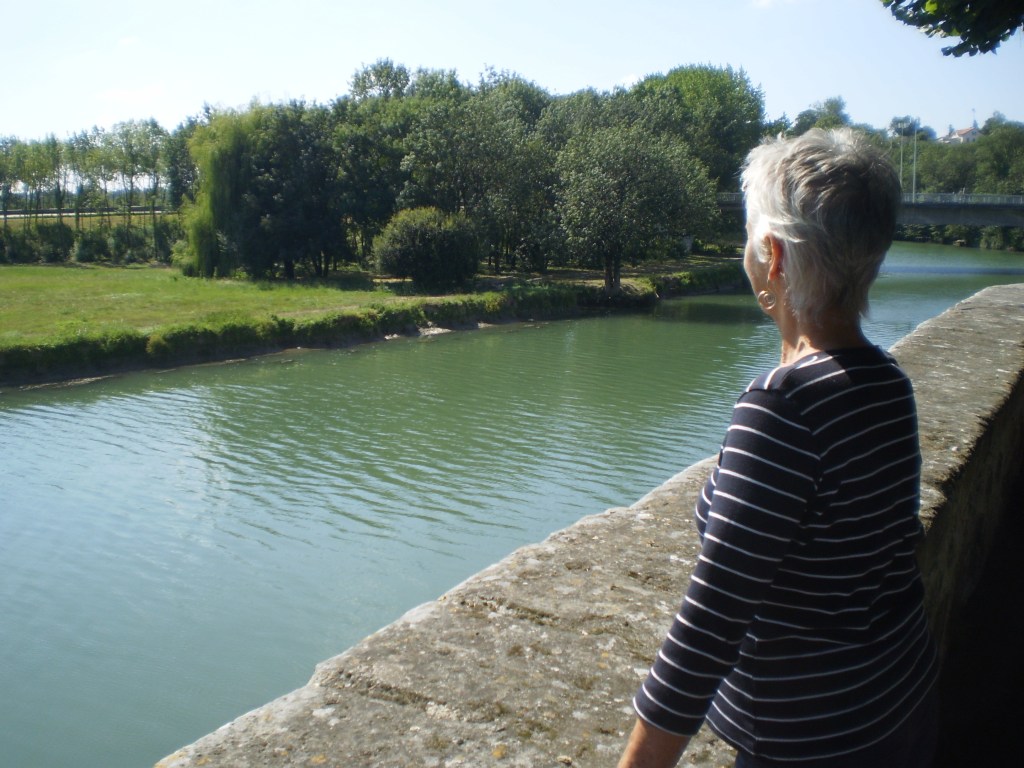
Ann ap on the banks of the Charente river in Saintes





 The Fugitive Stag