
An Artist Tricks Google Maps Into Creating a Virtual Traffic Jam, Using a Little Red Wagon & 99 Smartphones http://www.openculture.com/?p=1073950 via @openculture
Month: February 2020
“And into the windows of my room …”
So many stones have been thrown at me,
That I'm not frightened of them anymore,
And the pit has become a solid tower,
Tall among tall towers.
I thank the builders,
May care and sadness pass them by.
From here I'll see the sunrise earlier,
Here the sun's last ray rejoices.
And into the windows of my room
The northern breezes often fly.
And from my hand a dove eats grains of wheat...
As for my unfinished page,
The Muse's tawny hand, divinely calm
And delicate, will finish it. (Anna Aknmatova)
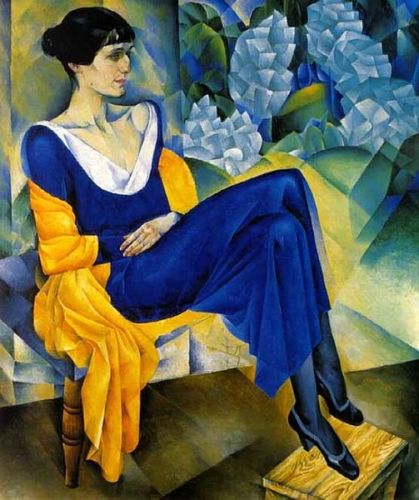
Anna! The woman who stood up to Stalin’s tormenting (psychological and emotional torture) – and outlived him by 13 years. A true warrior-poet. Earlier in her life Anna bewitched Amedeo Modigliani – theirs was a true meeting of hearts and minds.

A decaying ‘House’… and ‘a dry brain in a dry season,’ on Capitol Hill.
After such knowledge, what forgiveness? Think now
History has many cunning passages, contrived corridors
And issues, deceives with whispering ambitions,
Guides us by vanities.
From T S Eliot's 'Gerontion' (1919, published 1920)
This poem is considered to be the preface of a long and one of the most important poems of 20th century, T.S.Eliot’s ‘Wasteland.’
The poem speaks of people covering the truth with darkness, taking only bits of the truth on board and and interpreting it as they see fit.
I wonder what the American born Eliot/Gerontion would make of 6 February 2020 USA? He would probably write another brutally honest and depressing poem, another lament for a lost age.
Eliot writes of a civilization founded on monetary values and secular rationalism, with little genuine religious or human sense of community – a nightmare world of isolation and instability, of restless nervous and intellectual activity, emotional stagnation and spiritual drought.
Michael Hollister comments:
“As a result of not fighting for the values of a living tradition, the modern world is now owned and enslaved by the only proliferating element in it, the international money power.”
The poem even mentions the ‘Landlord of the House’ (‘a dull head among windy spaces’), the current owner, who is barren and corrupt.
The final images of drought and sterility lead directly to the atmosphere of ‘The Waste Land.’ Both poems highlight the corruption of European religion, culture and sexuality, a century ago. Ring any bells!
Gerontion, ‘the little old man,’ is a powerful image of a moribund civilization. He is near death, and shares some attributes with another modern man to whom Eliot gave his careful attention, the Kurtz of Conrad’s ‘Heart of Darkness’ (and later Coppola’s ‘Apocalypse Now’), who said he was ‘lying here in the dark waiting for death.’
Alpensinfonie
A celebration of personal strength: intellectual, artistic, spiritual, that allowed Strauss to triumph where Mahler had been destroyed. Locus and character of this celebration is carefully laid out in Alpensinfonie, his own musical ‘Antichrist’ as well as an elegy for his friend Mahler.
This lies at the core of Strauss’ spirituality – the beauty found on earth, the down to earthiness of an Alpine mountain, the summit of the attainable and the desirable.

A dream from the late 1980’s
The final breakthrough came when I was liberated from everything that I had regarded as my ‘inwardness,’ my so-called ‘true-self.’
The identity that I had cherished for so long, was completely shattered.
Demolished.
In its place I was embraced, enveloped and ultimately empowered by ‘The Look,’ though I wasn’t fully aware of it at the time.
A pair of eyes. Mysterious eyes. Eyes which became the deepest source of meaning for me, even when they were veiled or even closed!
Sometimes more so when they were shut.
And the more she glanced at me, the more ruthless she was in negating all the concepts and images that had hitherto sustained me in my spiritual life.
And everything that I had thought of as embodying the divine and human?
Gone!
But in that act of annihilation, I found myself.

When the hounds bay …
“When the hounds bay, we know we are in the saddle!”
Mahler’s Third Symphony was received with some hostility upon its first few hearings. After the second performance on 13 December 1895, Bruno Walter claimed, “To be sure, there was hostility, misunderstanding, belittlement, scorn. Yet the work left such a deep impression of greatness and originality of the force of Mahler’s personality, that one may date his rise to fame as a composer from that day.”
The hostility led Mahler to exclaim, “When the hounds bay, we know we are in the saddle!”

“And there I will give you a hundred hounds; No mightier creatures bay at the moon” – from W B Yeats ‘The Wanderings of Oisin.’
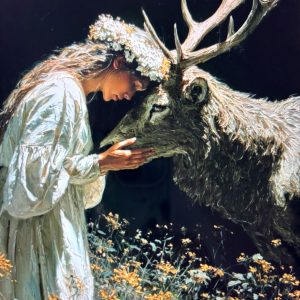
 The Fugitive Stag